Posts

Showing posts with the label High Rise

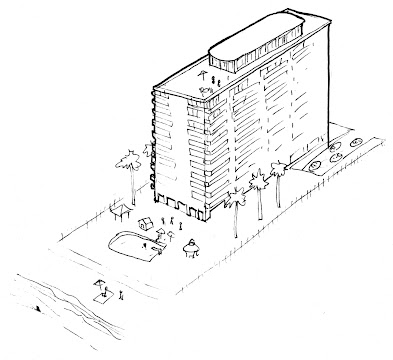
Beachfront Condo

Image
  Time period: 1960s to present Location: Florida, as well as other coastal cities and resort towns Up until the industrial era, beachfront property was not desirable. Unless someone's work required them to live near the ocean, people avoided beaches. There were good reasons: storms, pirates, and other invasions. Most large cities in Europe - even some major ports - are located inland.  This changed with the Industrial Revolution. In England, the rich started going to the beach to get away from pollution in the city, and the beach gained a new image as a healthy place to exercise or recover from disease. By the 1800s beachgoing had spread to the upper class in the US as well, with cities such as Cape May in New Jersey attracting tourists, many of who arrived by boat - Cape May is the closest spot on the shore to Philadelphia by boat. A growing middle class and the construction of railroads led to further development of East Coast beach towns. Most of these beach towns remained...
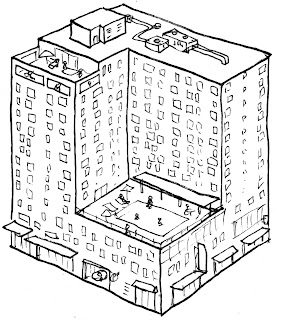
Student Apartment Tower

Image
  Time period: 21st century Location: Within walking distance of a flagship state university Large apartments designed to be shared by roommates, plus amenities and retail. If you live in a college town, chances are you've seen a number of large apartment towers pop up on the skyline just outside campus. These massive buildings, the largest of which house over 1,000 students, might be called "luxury student housing" or "student containment blocks" depending on who you ask.  They are the result of a number of trends that started as far back as the 1970s and have converged today.  Unlike other apartments that often end up stuck with vacant retail spaces due to there being too much retail space relative to the number of customers, student housing has a high enough population density to support first floor retail. Dining, cafes, and bubble tea are common retail tenants, so the space should be built kitchen-ready. Enrollment Trends at Public Universities In the USA...

Mechanical Void

Image
  Time period: 2010s Location: New York City How to get better views while staying under the floor area limit. Key features - Extra-high mechanical rooms on lower floors, with ceiling height of 100 feet or more. - Upper floors of multimillion dollar views. While supertall towers are extraordinary buildings, I have included them in this survey of housing as they come from the same roots as a stucco box apartment or suburban tract house: they are not custom homes designed by the future resident. They are a commodity, designed to make money. The history of zoning in New York is a constant back-and-forth between an economy that makes tall buildings profitable, and zoning laws that limit their height and bulk. The mechanical void ban is one of the latest chapters of this story. The modern skyscraper dates back to the invention of the elevator and the Bessemer process,which made it possible to mass produce steel.  Both were invented in the 1850s, and together they made taller buildi...

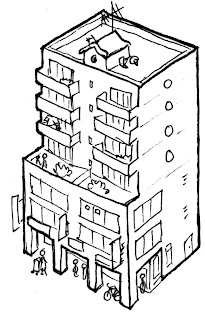
Chinatown Retail/Office/Housing Mixed Use Building

Image
    Time period: Late 19th century and 1970s to present Location: Urban Chinatowns, especially California's Bay Area and New York City Asian-style mixed use in the US Key features - Housing on top of space for small businesses - Financed by a mix of foreign and domestic investment In the United States, Chinatowns are some of the most densely populated neighborhoods. The origins of this dates back to the late 19th century, when racist laws and violence forced Chinese Americans into limited areas in each city, being unwelcome elsewhere. Out of necessity, these neighborhoods contained both housing and businesses and grew upwards as population increased.  During this era, many tong halls were built.  Financed by tongs (organizations made up of a group of Chinese Americans from the same family, occupation, region, or other affiliation), tong halls had businesses on the lower floors, sleeping rooms on the upper floors, and a meeting hall on the top.  Many continue ...