Posts

Showing posts with the label Northeast

Point Access Block

Image
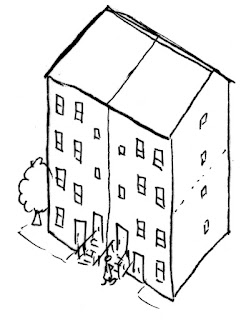
Time period: Late 19th and early 20th century, revived in 21st century. Location: Used to be everywhere.  Today: Seattle and New York City. A mid-rise building with a couple apartments on each floor.   In most cities, you'll find two types of mid-rise apartment buildings in the 4-7 story range. First, there'll be some small historic buildings downtown, side by side like books on a shelf. These are the original point access blocks. Then, there are the big modern buildings taking up a whole block and with long, windowless hallways inside. These are double loaded corridor buildings. Floorplan of a point access block.   Note that apartments have windows facing the front and back of the building.     In contrast, except for the corner units, apartments in a double loaded corridor only have windows facing one direction. Both the point access block and the double loaded corridor were designed to be the most efficient floorplan given the building codes of th...
Stacked Townhouse

Image
  Time period:1990s to present Location: Washington, DC metropolitan area, also found in other places. Twice the density, half the land cost: a 2-story townhouse on top of another 2-story townhouse Key features - Family sized housing, with 3+ bedrooms. - Marketed as townhouses, cheaper than regular townhouses . - Also known as a "2 over 2" Rowhouses and townhouses historically have been a popular housing type in the Mid-Atlantic region, stretching from New Jersey down to Northern Virginia.   The stacked townhouse is the latest version of this type.   The Washington DC are has become one of the fastest growing and wealthiest metropolitan areas in the country in the last 20-30 years, boosted by the growing role of the federal government. Many businesses that are heavily affected by federal regulations and/or reliant on federal subsidies, such as healthcare, defense, and telecommunications, have decided to have their headquarters in or near DC, even if manufacturing ta...

Chinatown Retail/Office/Housing Mixed Use Building

Image
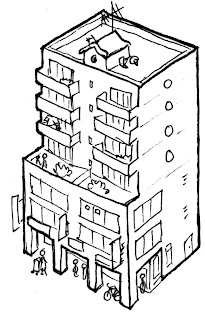
    Time period: Late 19th century and 1970s to present Location: Urban Chinatowns, especially California's Bay Area and New York City Asian-style mixed use in the US Key features - Housing on top of space for small businesses - Financed by a mix of foreign and domestic investment In the United States, Chinatowns are some of the most densely populated neighborhoods. The origins of this dates back to the late 19th century, when racist laws and violence forced Chinese Americans into limited areas in each city, being unwelcome elsewhere. Out of necessity, these neighborhoods contained both housing and businesses and grew upwards as population increased.  During this era, many tong halls were built.  Financed by tongs (organizations made up of a group of Chinese Americans from the same family, occupation, region, or other affiliation), tong halls had businesses on the lower floors, sleeping rooms on the upper floors, and a meeting hall on the top.  Many continue ...

Bayonne Box

Image
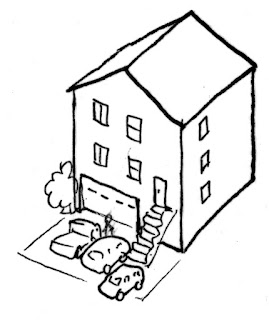
Time period:1990s to present Location: Northern New Jersey The Bayonne Box combines urban living with parking.  It is named after a North Jersey city located across the Hudson River from New York City. Key features - Large house with parking on a small urban lot (typically a 25 foot to 40 foot wide by 100 feet deep lot) - Three-story building with garage and front yard parking - Typically has a large home, may also have additional apartments North Jersey cities were built out like most northeastern US cities: neat rows of narrow houses.  Faced with a few decades of falling population caused by factory closures and white people not wanting to live in racially integrated cities after the Civil Rights Act banned housing discrimination, there was very little new housing construction from the 1960s to the 1990s. Boosted by new immigrants plus city living becoming trendy again, North Jersey's urban cities started to grow again in the 1990s. Whether it was suburban dwellers returning...