Posts

Showing posts with the label Mid Rise

Student Apartment Tower
Image
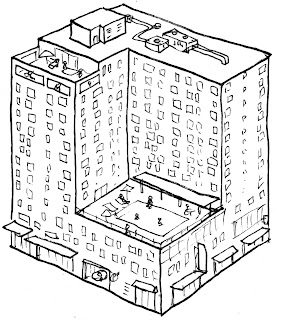
  Time period: 21st century Location: Within walking distance of a flagship state university Large apartments designed to be shared by roommates, plus amenities and retail. If you live in a college town, chances are you've seen a number of large apartment towers pop up on the skyline just outside campus. These massive buildings, the largest of which house over 1,000 students, might be called "luxury student housing" or "student containment blocks" depending on who you ask.  They are the result of a number of trends that started as far back as the 1970s and have converged today.  Unlike other apartments that often end up stuck with vacant retail spaces due to there being too much retail space relative to the number of customers, student housing has a high enough population density to support first floor retail. Dining, cafes, and bubble tea are common retail tenants, so the space should be built kitchen-ready. Enrollment Trends at Public Universities In the USA...

Point Access Block

Image
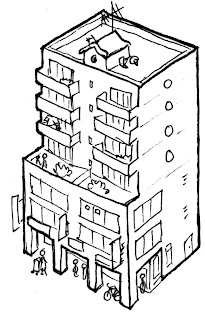
Time period: Late 19th and early 20th century, revived in 21st century. Location: Used to be everywhere.  Today: Seattle and New York City. A mid-rise building with a couple apartments on each floor.   In most cities, you'll find two types of mid-rise apartment buildings in the 4-7 story range. First, there'll be some small historic buildings downtown, side by side like books on a shelf. These are the original point access blocks. Then, there are the big modern buildings taking up a whole block and with long, windowless hallways inside. These are double loaded corridor buildings. Floorplan of a point access block.   Note that apartments have windows facing the front and back of the building.     In contrast, except for the corner units, apartments in a double loaded corridor only have windows facing one direction. Both the point access block and the double loaded corridor were designed to be the most efficient floorplan given the building codes of th...

Texas Donut (Wrap)

Image
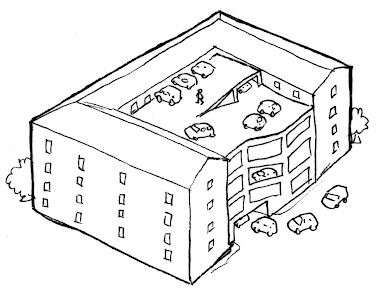
  Time period: Late 20th century to present Location: Suburban downtowns and car-centered cities across the country How to provide lots of apartments, while hiding the parking. Key features - Mid-rise apartment building wrapped around a multi-story parking garage. - Requires large piece of land. - Higher density than garden apartments, less dense than a podium building. Everything's bigger in Texas - including the apartment buildings. After World War II, advances in air conditioning technology made urban living in hot and humid climates more desirable. Texas was also going through an oil boom. While oil fields tapped out and production peaked in the 1970s, the state's early lead in oil production locked in its position as a headquarters for oil companies, as well as banks and suppliers that supported oil drilling elsewhere in the world.  Since the 2010s, the fracking boom has brought a new wave of oil related jobs to Texas. While its main Sunbelt rival - California - went down...

Chinatown Retail/Office/Housing Mixed Use Building

Image
    Time period: Late 19th century and 1970s to present Location: Urban Chinatowns, especially California's Bay Area and New York City Asian-style mixed use in the US Key features - Housing on top of space for small businesses - Financed by a mix of foreign and domestic investment In the United States, Chinatowns are some of the most densely populated neighborhoods. The origins of this dates back to the late 19th century, when racist laws and violence forced Chinese Americans into limited areas in each city, being unwelcome elsewhere. Out of necessity, these neighborhoods contained both housing and businesses and grew upwards as population increased.  During this era, many tong halls were built.  Financed by tongs (organizations made up of a group of Chinese Americans from the same family, occupation, region, or other affiliation), tong halls had businesses on the lower floors, sleeping rooms on the upper floors, and a meeting hall on the top.  Many continue ...